Abstract. A rational skincare routine is much shorter than the cosmetics industry’s narrative suggests. Three products can do 80% of the job; five cover almost every real need. Here I lay out a practical synthesis: the minimal routine for those without specific concerns, the complete routine for anyone targeting photo-ageing or dyschromia, the order of application, the most common mistakes, and when it makes sense to move from the bathroom mirror to the aesthetic-medicine chair. Third and final part of a series, in continuity with Skincare: actives, concentrations and medical grade — the second part, devoted to the actives applied at home and to the real difference between over-the-counter and medical grade products.
By this point in the series we have dismantled a lot. Most of the heavily marketed aesthetic-medicine treatments don’t have the evidence the marketing suggests. Most of the trendy skincare ingredients don’t do what they promise. Most of the routines described by magazines and social channels are oversized, underdosed, or both.
One practical question remains. So what do I put on, in what order, how often?
The honest answer is short. Three or four products, used consistently for months, do the job most people are after when they walk into a beauty store with a shopping list of thirteen items. Adding products rarely improves the result — more often it makes it worse, irritating skin that would have responded better to less.
This third part is the practical synthesis of the first two. Nothing new, but everything pulled together.
1. The principle: few actives, right doses, consistency
Skin responds to three things, in order of importance:
Consistency. A retinoid used for six months changes the skin. The same retinoid used for two weeks does nothing. Almost every cosmetic active works on a timescale of weeks or months — not days. The most powerful routine is the one you can actually stick with.
Effective dose. Below the documented threshold of efficacy, an active is just a label. Above the threshold, it starts doing what the literature describes. The “a tiny drop is enough” line is usually an excuse to justify underdosed formulations.
Few actives at a time. The skin’s ability to tolerate actives is limited. Layering a retinoid, a vitamin C, a glycolic acid, a niacinamide and an enzymatic peel — even all dosed correctly — is a recipe for chronic irritation, not for better skin. The serious combinations are few and well-considered.
To these three add one simple observation: sunscreen is the only non-negotiable step. Everything else is optional and depends on individual needs; daily sunscreen is the single cosmetic gesture with the best documented impact on photo-ageing. It’s boring, it’s cheap and it works.
2. The minimal routine
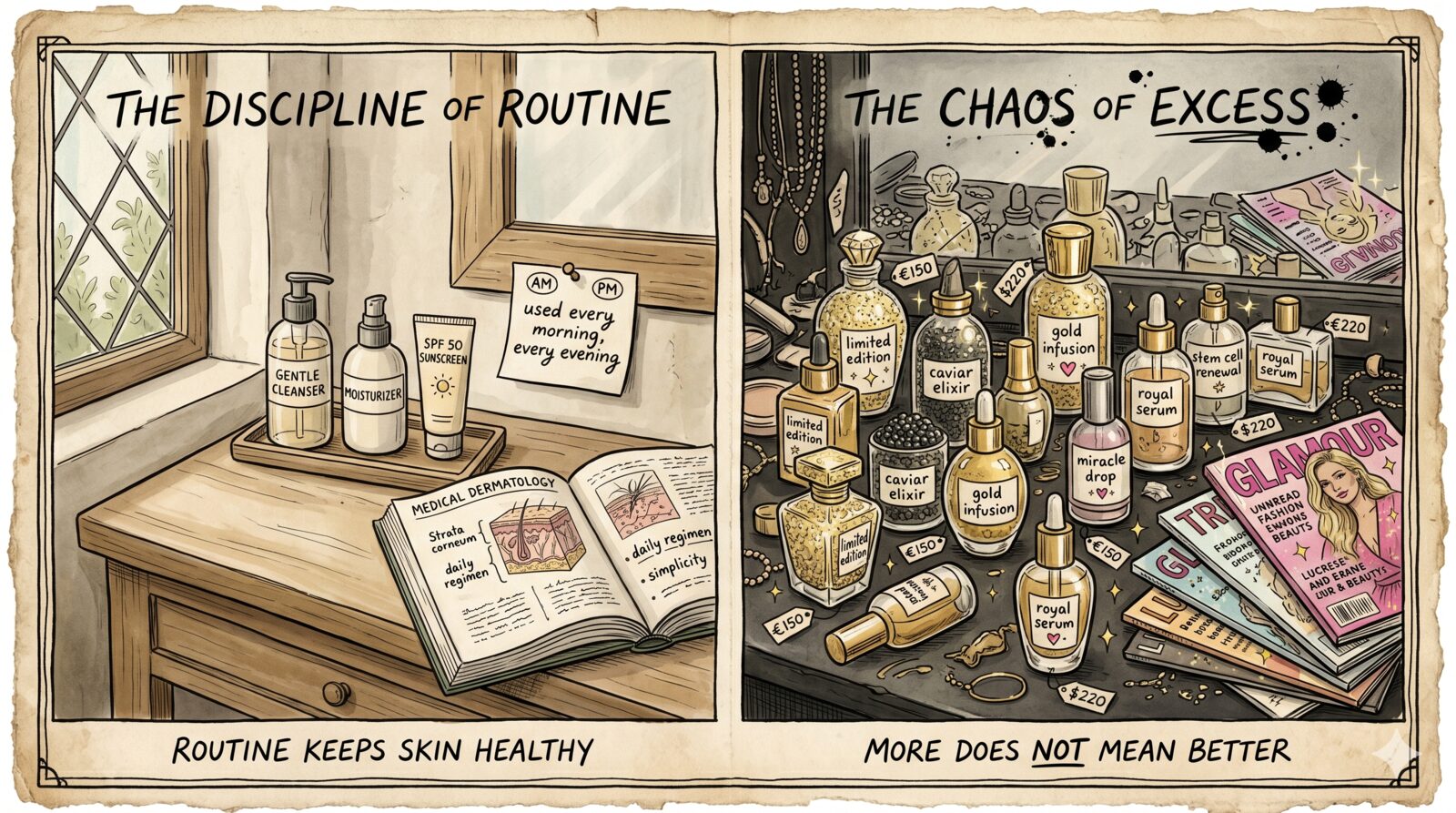
Three products. For most healthy people, with no specific dermatological concerns, that’s already enough to get — over time — skin in good condition.
Morning:
- Gentle cleanser at slightly acidic pH (4–5), without aggressive sulphates. The aim is to remove overnight sebum without damaging the barrier. If the skin feels tight after washing, the cleanser is too aggressive.
- Sunscreen with broad-spectrum coverage (UVA + UVB), SPF 30+, applied every morning, even in winter, even indoors if you spend long hours near windows. The formulation you actually like to use is better than the “technically superior” one you skip.
Evening:
- Gentle cleanser (the same as the morning, or an oil cleanser if you wear make-up or water-resistant sunscreen).
- Simple moisturiser with ceramides, glycerin, possibly niacinamide. Nothing exotic.
This is the base. It’s not “minimal out of laziness”: it’s the foundation on top of which — only if needed — actives are added.
3. The complete routine: adding actives
If there are specific concerns — photo-ageing, dyschromia, adult acne, texture quality — one or two actives are added to the base. Not three, not four. Adding products is almost always less effective than properly dosing the ones already in the routine.
Evening, two or three times a week (then more often):
- Retinoid. The single active with the largest documented impact on skin quality over time. Start at low concentrations (retinol 0.3% or retinaldehyde 0.05%) two or three evenings a week. Increase concentration and frequency only once the skin has built up tolerance. If you’re ready for a dermatological protocol, prescription tretinoin is the reference.
Morning or evening, depending on the concern:
- One target active, chosen for what you actually need. Just one. The most common combinations:
- Vitamin C (L-ascorbic acid 10–20% in a stabilised formulation) in the morning, for photo-ageing and tissue quality.
- Niacinamide at 5–10% for skin barrier and tone.
- Azelaic acid at 10–20% for post-inflammatory marks, rosacea, adult acne.
- Salicylic acid at 1–2% for oily, acne-prone skin.
- AHAs (glycolic 5–10% or lactic) as a chemical exfoliant twice a week, if the skin looks dull or uneven.
Well-cared-for skin is built on the sum of a few coherent gestures, not on the accumulation of products.
4. The order of application
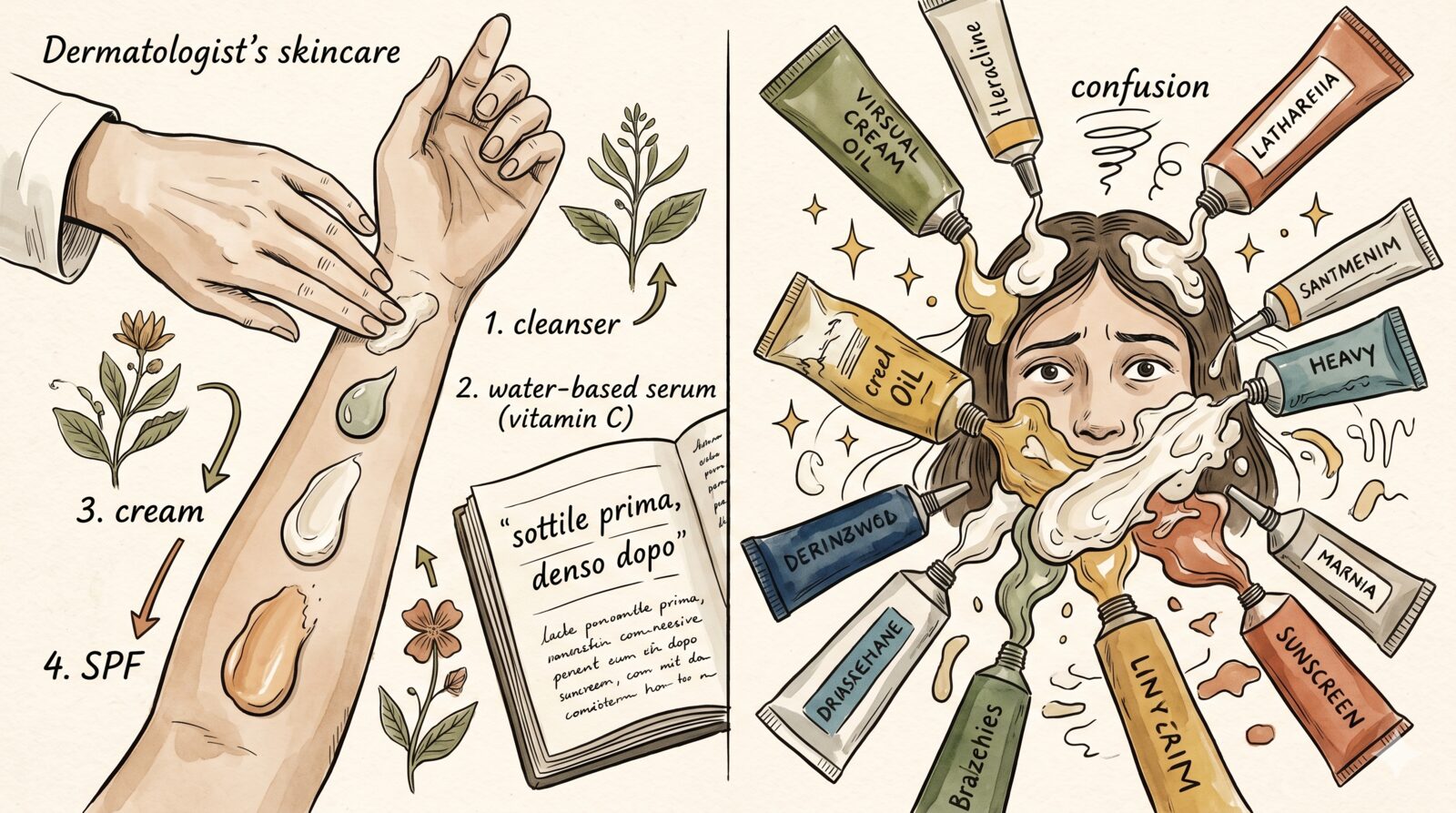
A simple, fairly robust rule: from thinnest to thickest, from most acidic to most neutral, always leaving a few minutes between one active and the next so each can do its job.
Morning, example:
- Cleanser
- Toner (optional, often unnecessary if the cleanser is well chosen)
- Active serum (for example vitamin C)
- Moisturiser
- Sunscreen
Evening, example:
- Cleanser
- Target active (for example azelaic acid) — only if it isn’t incompatible with the retinoid
- Retinoid (let the skin dry properly before applying)
- Moisturiser (possibly “buffered” on top to reduce retinoid irritation on sensitive skin)
Don’t layer vitamin C and a retinoid in the same step. Don’t combine a retinoid and strong AHAs on the same evening. Don’t apply a chemical exfoliant on the same evening as the retinoid.
5. Common mistakes
The mistakes I see most often, in order of frequency:
Layering too many actives. More is not better. Three strong actives applied together usually produce inflamed skin, not improved skin. If the routine is too loaded, remove, don’t add.
Changing too often. A serious active needs six to twelve weeks to show the first results. Switching products every two weeks because “you can’t see anything” is the surest way to never see anything.
Chronic exfoliation. Glycolic acid every day, salicylic across five different products, weekly enzymatic peels, scrubs. The skin barrier has a regenerative capacity, but it’s not infinite. Over-exfoliated skin has been one of the most widespread dermatological conditions of the past decade.
Skipping sunscreen. Without the foundation that prevents daily sun damage, the value of every other active is overstated.
Underdosing actives. “A drop of retinol on Monday evening every three weeks” is not a protocol, it’s a placebo. Actives have to be used at the concentrations and frequencies the literature has actually studied — which means accepting some initial irritation.
Buying the trendy product. The skincare industry refreshes its “must-have” every season. The retinoid has been working for forty years; the product of the moment, usually, hasn’t.
6. When to move on to aesthetic medicine

Even a perfect routine has limits. When the concerns go beyond what topical skincare can do — advanced photo-ageing, volume loss, significant laxity, deep dyschromia, scarring — skincare remains the foundation but is supported by procedures that work at deeper levels.
The triage rule, in short (we covered it in detail in the first part):
- Dynamic wrinkles (forehead, glabellar, crow’s feet): botulinum toxin.
- Volume loss (cheekbones, temples, chin): cross-linked hyaluronic-acid filler, in expert hands. With restraint.
- Facial and neck laxity, tissue quality, deep hydration: bioremodellers like Profhilo, classic biostimulators (Sculptra, Radiesse) for established indications.
- Superficial spots, photo-ageing, acne scars: ablative fractional lasers, medium chemical peels, possibly microneedling.
- Deep dyschromia, melasma: a combination of medical-grade skincare (azelaic acid, hydroquinone if prescribed, retinoids) and selected dermatological procedures. Never aggressive lasers on melasma without careful evaluation.
To avoid, for almost everyone, unless there’s a specific reason: HIFU as a “non-surgical lift”, injectable vitamin cocktails, mesotherapy for cellulite or “rejuvenation”, radiofrequency as a primary treatment.
And one general principle: aesthetic medicine is a tool, not a solution. It works best when it complements a skincare routine that’s already well-built; it works worst when it’s asked to be a shortcut for neglected skin. The doctor’s chair comes after the mirror, not in place of it.
7. When to see a dermatologist
Most people don’t need a dermatologist to build a routine. They need one when signs emerge that over-the-counter skincare can’t handle:
- Moderate or severe acne, especially if cystic or nodular.
- New, asymmetric or changing spots (any mole that changes colour, borders or size needs evaluation).
- Rosacea with vascular or pustular components.
- Melasma or hyperpigmentation resistant to skincare.
- Eczema, psoriasis, chronic dermatitis.
- Persistent adverse reactions to suspected allergenic products.
- Significant or unusual hair loss.
A serious dermatology check-up, every two or three years in the absence of problems, is also good preventive practice — especially for monitoring moles. It costs less than three trendy creams.
Closing the series
In three articles we started from aesthetic-medicine treatments, moved through the ingredients applied at home, and arrived at the most reduced form of the original question: what should I actually do?
The answer isn’t elegant. There’s no secret protocol, no exclusive brand, no life-changing serum. There’s the combination of a few honest gestures, repeated for months, chosen on the basis of evidence rather than advertising. There’s the care taken not to damage what already works — the skin barrier, the integrity of the skin, the balance of the microbiota — just to chase a new product.
And there’s an uncomfortable truth that closes the series: skin ages anyway. It’s not a defeat, it’s a fact. A good routine, consistent sun protection, a few clinical choices made at the right moment make the path more dignified and the skin healthier — not eternal. Promising the opposite is precisely the marketing we’ve tried to dismantle in these three pieces.
Everything else, in the end, is cosmetics. And that’s fine.
Essential bibliography
Few references, chosen for the article’s load-bearing claims: daily sunscreen as the single measure with the best documented impact on photo-ageing (Hughes’ four-year RCT), tretinoin as the reference retinoid in both short-term trials and long-term follow-up, barrier repair with ceramide-dominant lipids, the evidence on chemical exfoliants for acne, and adherence as the crucial variable.
- Hughes MCB, Williams GM, Baker P, Green AC. Sunscreen and prevention of skin aging: a randomized trial. Ann Intern Med. 2013;158(11):781-790. PMID: 23732711
- Kligman AM, Grove GL, Hirose R, Leyden JJ. Topical tretinoin for photoaged skin. J Am Acad Dermatol. 1986;15(4 Pt 2):836-859. PMID: 3771853
- Cho S, Lowe L, Hamilton TA, Fisher GJ, Voorhees JJ, Kang S. Long-term treatment of photoaged human skin with topical retinoic acid improves epidermal cell atypia and thickens the collagen band in papillary dermis. J Am Acad Dermatol. 2005;53(5):769-774. PMID: 16243124
- Chamlin SL, Kao J, Frieden IJ, et al. Ceramide-dominant barrier repair lipids alleviate childhood atopic dermatitis: changes in barrier function provide a sensitive indicator of disease activity. J Am Acad Dermatol. 2002;47(2):198-208. PMID: 12140465
- Liu H, Yu H, Xia J, et al. Topical azelaic acid, salicylic acid, nicotinamide, sulphur, zinc and fruit acid (alpha-hydroxy acid) for acne. Cochrane Database Syst Rev. 2020;5(5):CD011368. PMID: 32356369
- Ahn CS, Culp L, Huang WW, Davis SA, Feldman SR. Adherence in dermatology. J Dermatolog Treat. 2017;28(2):94-103. PMID: 27180785